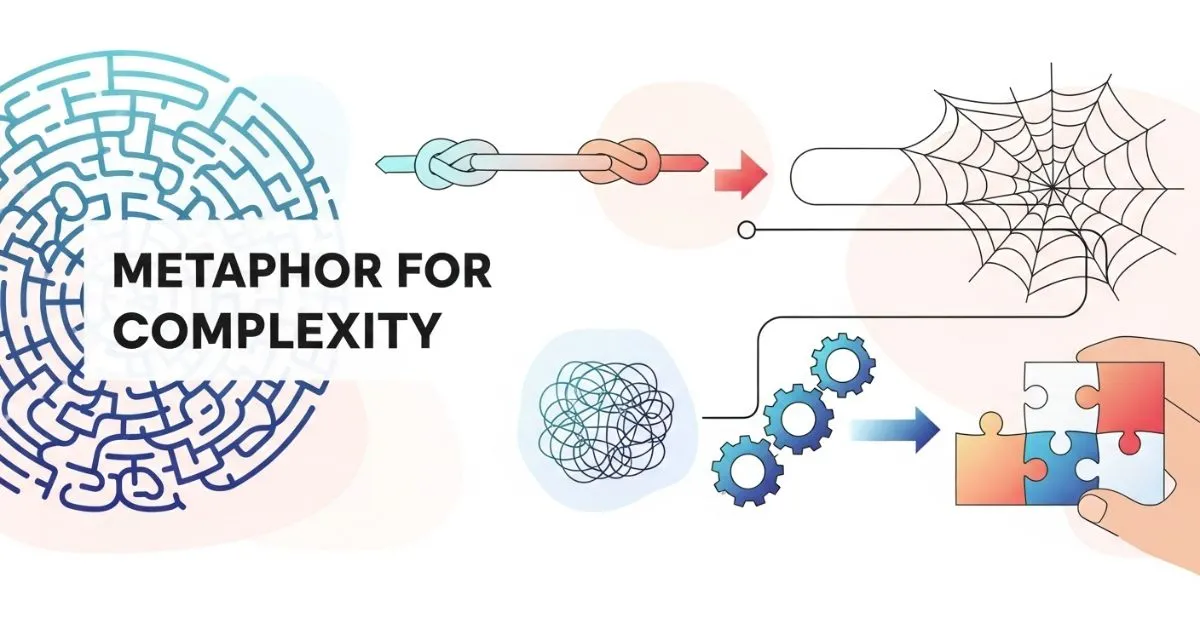
Sometimes things in life are not simple, and that’s where we use metaphors for complexity to explain them in an easy way. Imagine trying to understand something that feels like a big puzzle with many pieces that’s what complexity is like.
But don’t worry, metaphors help us turn these hard ideas into simple pictures in our minds. When I use a metaphor, I’m just comparing something complicated to something we already know. This makes it easier to understand, even for a child.
In this article, I’ll share how metaphors can make complex ideas feel clear and simple, just like telling a story.
20 Metaphors for Complexity
1. “The problem was a tangled web.”
Meaning: The situation was very complicated.
Explanation: A web has many interconnected threads.
Examples:
- The case turned into a tangled web of lies.
- His excuses created a tangled web.
2. “Her thoughts were a maze.”
Meaning: Her thinking was confusing and hard to follow.
Explanation: Mazes are difficult to navigate.
Examples:
- His plan felt like a maze of ideas.
- I got lost in her maze of thoughts.
3. “The system was a puzzle with missing pieces.”
Meaning: It was hard to fully understand.
Explanation: Missing pieces make puzzles incomplete.
Examples:
- The report was a puzzle with missing pieces.
- Their story felt incomplete like a puzzle.
4. “His mind was a knot.”
Meaning: He was mentally confused.
Explanation: Knots are twisted and hard to untangle.
Examples:
- Stress turned his mind into a knot.
- My thoughts became a tight knot.
5. “The project was a jungle.”
Meaning: It was chaotic and hard to manage.
Explanation: Jungles are dense and confusing.
Examples:
- Managing it felt like entering a jungle.
- The files turned into a jungle of data.
6. “Her plan was a labyrinth.”
Meaning: It was extremely detailed and complex.
Explanation: Labyrinths are intricate and winding.
Examples:
- The strategy became a labyrinth.
- His explanation sounded like a labyrinth.
7. “The situation was a spider’s web.”
Meaning: Everything was interconnected and tricky.
Explanation: Webs trap and connect things.
Examples:
- He was stuck in a spider’s web of problems.
- The politics formed a web.
8. “His explanation was a fog.”
Meaning: It was unclear and confusing.
Explanation: Fog blocks clear vision.
Examples:
- The lecture felt like walking through fog.
- His answer was pure fog.
9. “The issue was a Rubik’s cube.”
Meaning: It required effort to solve.
Explanation: A cube puzzle is challenging.
Examples:
- The problem was a Rubik’s cube.
- Solving it felt like twisting a cube.
10. “Her emotions were a storm.”
Meaning: She felt overwhelmed.
Explanation: Storms are intense and chaotic.
Examples:
- Her mind was a storm of confusion.
- He faced a storm of feelings.
11. “The code was a tangled wire.”
Meaning: It was messy and confusing.
Explanation: Tangled wires are hard to sort.
Examples:
- The program looked like tangled wires.
- Fixing it was like untangling cables.
12. “His story was a patchwork quilt.”
Meaning: It had many mixed parts.
Explanation: Quilts combine different pieces.
Examples:
- The narrative was a patchwork quilt.
- Her explanation felt stitched together.
13. “The argument was a knotty rope.”
Meaning: It was difficult to resolve.
Explanation: Knotty ropes are hard to untie.
Examples:
- The debate became a knotty rope.
- Their issue remained tangled.
14. “Her schedule was a spinning plate.”
Meaning: She was managing many things at once.
Explanation: Spinning plates require balance.
Examples:
- Her life was a spinning plate act.
- He struggled to keep everything spinning.
15. “The theory was a deep ocean.”
Meaning: It had many layers to explore.
Explanation: Oceans are vast and deep.
Examples:
- Physics felt like a deep ocean.
- His ideas had ocean-like depth.
16. “His mind was a crowded room.”
Meaning: He had too many thoughts.
Explanation: Crowded rooms feel overwhelming.
Examples:
- My brain was a crowded room.
- Her ideas filled the space.
17. “The system was a machine with many gears.”
Meaning: Many parts worked together.
Explanation: Machines have interconnected parts.
Examples:
- The company worked like many gears.
- It was a machine of processes.
18. “Her explanation was a layered cake.”
Meaning: It had many levels of detail.
Explanation: Cakes have multiple layers.
Examples:
- The topic was a layered cake.
- Each layer revealed more meaning.
19. “The rules were a thick forest.”
Meaning: They were hard to understand.
Explanation: Forests are dense and confusing.
Examples:
- The policy was a thick forest.
- He got lost in the rules.
20. “The concept was a winding road.”
Meaning: It was not straightforward.
Explanation: Winding roads have many turns.
Examples:
- Learning it felt like a winding road.
- His logic followed many turns.
Practical Exercise: Metaphor for Complexity
Questions
- Which metaphor shows confusion like getting lost?
- What metaphor represents something unclear?
- Which metaphor suggests many connected parts?
- What metaphor shows emotional overload?
- Which metaphor represents something deep and layered?
- What metaphor shows managing many tasks?
- Which metaphor suggests a messy structure?
- What metaphor represents something hard to untangle?
- Which metaphor shows something not straightforward?
- What metaphor suggests missing information?
Answers
- Maze / labyrinth / jungle
- Fog
- Machine with many gears / spider’s web
- Storm
- Deep ocean / layered cake
- Spinning plate
- Tangled wire
- Knot / knotty rope
- Winding road
- Puzzle with missing pieces
Conclusion
Complex ideas don’t have to stay confusing. With the help of metaphors, you can turn difficult concepts into clear and relatable images 🌟. If it’s a maze, a storm, or a deep ocean, these comparisons make it easier to understand and explain complicated situations. The more you practice using these metaphors, the better you’ll become at simplifying even the most challenging topics in your writing and conversations 🙂.
Discover More Article:
- 20 Beautiful Metaphors for a Sleeping Cat You’ll Love (2026)
- 20 Creative Metaphors for Having Fun with Simple Examples
- 20 Powerful Metaphors for Embarrassment in Writing (2026)

Emerson Hayes is a U.S.-based writer passionate about language, creativity, and literary expression. At Mitaphar.com, Emerson explores metaphors and storytelling that make complex ideas feel vivid, relatable, and inspiring.